Storm Agnes Emergency: Hung-Up Beech Tree in Lewisham
Storm Agnes hit the UK in September 2022 and brought a record number of storm-damaged trees to the attention of tree surgeons across the country. South London was no exception. Tree Surgeons in South London was among the many tree surgery companies across the city providing emergency support to homeowners, local authorities, and land managers dealing with fallen and damaged trees.
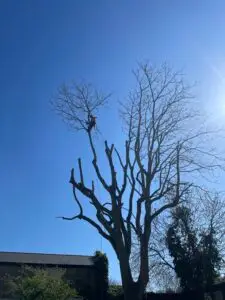
Of all the emergency jobs we attended during and after Storm Agnes, one stood out — an extra-large beech tree (Fagus sylvatica) in a wooded section of a public park in Lewisham.
The Situation
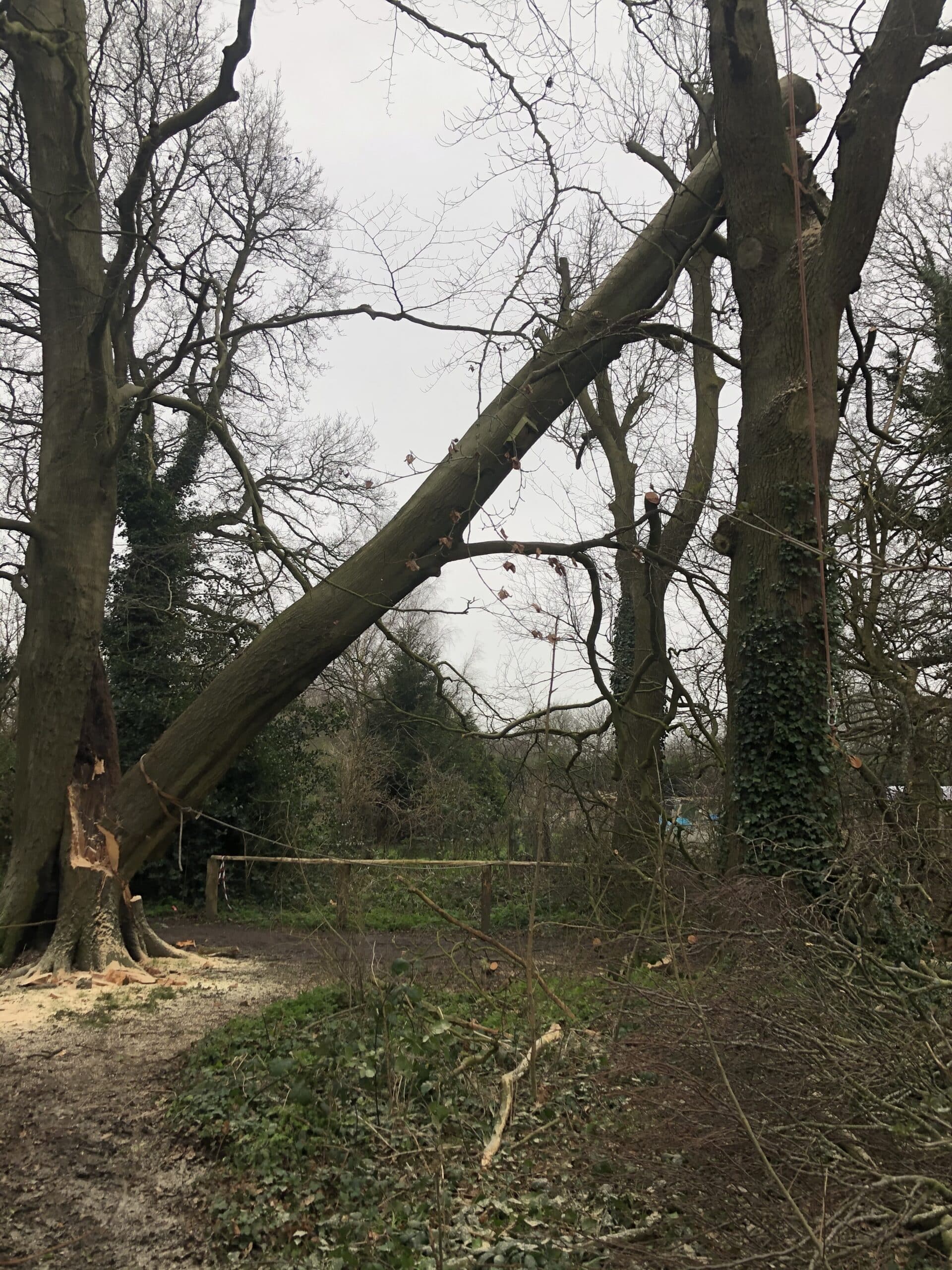
The beech had two co-dominant stems — two main trunks growing from the same point. During the storm, one co-dominant stem snapped out completely at the junction and fell into a neighbouring oak tree, where it became hung up in the oak’s crown.
The fallen stem was massive. It was suspended at height, caught across the crown break of the oak, with its base still resting on the original stump. The tree sat directly over a public footpath running through the wooded section of the park. The path needed to be closed immediately.
This was not a routine emergency callout. Hung-up trees are among the most dangerous situations in tree surgery. A large tree caught in another tree contains enormous stored energy — it is under tension, under compression, and can shift unpredictably when any part of it is cut. The forces involved can catapult timber in unexpected directions, and the tree it is hung in can fail under the additional weight at any time.
Because of the complexity and risk, several tree surgery companies turned the job down. Our team assessed the situation and accepted it.
Why Hung-Up Trees Are So Dangerous
A hung-up tree is not simply a fallen tree leaning against another. The weight of the fallen tree is transferred into the standing tree at angles and positions that the standing tree was never designed to bear. The standing tree can fail under that load without warning.
The fallen tree itself is under stress. Parts of it are in tension (being pulled) and parts are in compression (being squeezed). When you cut into a stressed trunk or branch, the stored energy releases — sometimes violently. A cut in the wrong place can cause the timber to spring, kick, or roll unpredictably.
Standard safety practice in the UK is clear: a hung-up tree should be dealt with from the ground wherever possible and should never be climbed. The Health and Safety Executive and the Forestry Commission’s guidance both emphasise that climbing a hung-up tree or the tree supporting it is an unacceptable risk.
Our 3-Step Approach
After assessing the situation, the risk, and the equipment available, our team devised a ground-based recovery plan.
Step 1: Anchor and stabilise. Before making any cuts, the team set anchor points using neighbouring trees to control the movement of the fallen stem when it was released. Slings and winch lines were rigged to provide pulling force in a controlled direction. The goal was to ensure that when the beech was freed from the oak, it would come down in a predictable direction — away from the footpath and any structures.
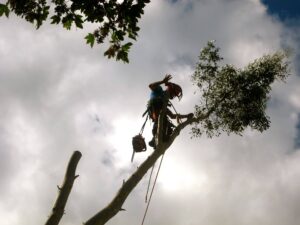
Step 2: Reduce the crown weight. Because so much of the fallen beech’s crown was caught up across the crown break of the oak, standard methods to bring the tree straight down from the ground could not be applied initially. The team needed to reduce the crown weight first — removing branches section by section to decrease the load on the oak and make the final pull-down more controllable. This was done from the ground using pole saws and carefully positioned cuts, always working from the safe side of the stem.
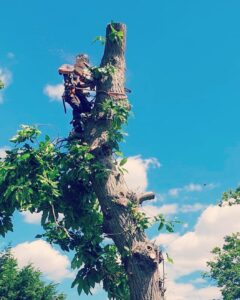
Step 3: Controlled release and felling. Once enough crown material had been removed and the anchor lines were tensioned, the team made the final cuts to release the beech from the oak. Using the winch lines for directional control, the stem was brought to the ground in a controlled drop into the cleared zone. The landing was clean and the oak sustained no significant damage.
Site Clearance
The fallen beech produced a large volume of timber and branchwood. The team processed everything on site — bucking the trunk into manageable log lengths and chipping the branchwood. The footpath was cleared and reopened. All waste was removed for recycling.
What This Job Demonstrates
This was not a job that could be handled by an operator with a chainsaw and a pickup truck. It required experienced arborists who understood the forces at play in a hung-up tree, could assess the risks honestly, and had the skill and equipment to carry out a safe ground-based recovery.
Several companies turned it down. We understand why — the risks were real, and any company that does not feel competent to handle a specific situation should say so. But our team had the experience and the training to assess the situation, plan the approach, and execute it safely.
Hung-up trees from storm damage are more common than most people realise. If you have a hung-up tree on your property or land following a storm, do not attempt to deal with it yourself or let an unqualified operator near it. The stored forces in a hung-up tree can cause catastrophic injuries. Call a qualified tree surgery company with experience in complex emergency work.
Understanding Storm Damage in South London
South London’s tree population is particularly vulnerable to storm damage for several reasons.
Clay soils. Much of South London sits on London Clay, which shrinks during dry periods and swells when wet. This repeated movement weakens root systems over time. When heavy rain saturates the ground before a storm, the loosened soil provides less anchorage — and trees fail at the roots.
Mature tree stock. South London’s parks, streets, and residential gardens contain a high proportion of large, mature trees — many planted 50-100 years ago. These trees have large canopies that catch significant wind load.
Co-dominant stems. Many broadleaf species develop co-dominant stems — two main trunks growing from the same point. If the junction between them contains included bark (bark trapped in the fork rather than a proper wood-to-wood union), it creates a structural weakness that can fail under storm loading. This is exactly what happened to the Lewisham beech.
Urban density. When a tree fails in South London, it rarely falls into an empty field. It falls onto footpaths, roads, buildings, fences, cars, and neighbouring properties. This increases both the damage caused and the complexity of the recovery operation.
After a Storm: What to Do
If a tree on your property has been damaged by a storm, follow these steps:
First, stay away from the tree. Do not walk under it, attempt to prop it up, or cut any part of it yourself. If it has brought down power lines, stay well clear and call your electricity network operator immediately.
Second, call a qualified tree surgeon. Describe the situation over the phone. A good company will assess the urgency honestly — some situations need immediate attendance, others can safely wait a day or two.
Third, do not rush into decisions about removal. A tree that looks dramatically damaged may still be saveable. Conversely, a tree that looks fine from the ground may have hidden structural damage. Wait for a professional assessment before committing to full removal.
Fourth, photograph everything. Take clear photos from several angles before any work is done. These are essential for insurance claims and, if the tree has a TPO, for retrospective notification to the council.
Frequently Asked Questions
What should I do if a tree falls on my property during a storm?
Stay away from it. Do not attempt to move or cut it yourself. Call a qualified tree surgeon for an assessment. If power lines are involved, also call your electricity network operator. Photograph the damage for insurance purposes before any work begins.
How quickly can you respond to storm damage in South London?
We aim to attend genuine emergencies on the same day. After major storms like Agnes, there can be a backlog — we prioritise by risk (trees on buildings and roads first) and keep every client updated on timelines.
Will my home insurance cover storm damage to trees?
In most cases, yes — particularly when a tree has fallen on a structure. Coverage varies by policy. We provide detailed invoices and timestamped photographs to support insurance claims.
What is a hung-up tree?
A hung-up tree is a tree that has failed but has not reached the ground — it is caught in another tree or structure. Hung-up trees contain stored energy and are extremely dangerous. They should only be dealt with by experienced professionals using appropriate techniques.
Can a storm-damaged tree be saved?
It depends on the extent of the damage. A tree that has lost a few branches can usually be saved through remedial pruning. A tree with a split trunk, significant root plate lift, or complete crown failure usually needs to come down. We assess each case individually and always recommend retention over removal if it is safe to do so.
Need Emergency Tree Surgery in South London?
If you have a tree emergency — fallen trees, hung-up trees, storm damage, hanging branches — call us now. We respond quickly across Lewisham, Greenwich, Southwark, Bromley, Lambeth, and all surrounding South London areas. We can usually be on site the same day.